From Postwar Nagoya to Queen Street: A Short History of Pachinko
Pachinko went from a children's board game to Japan's biggest entertainment industry to a Brisbane club floor in under a century. The road it took is stranger than you would guess.
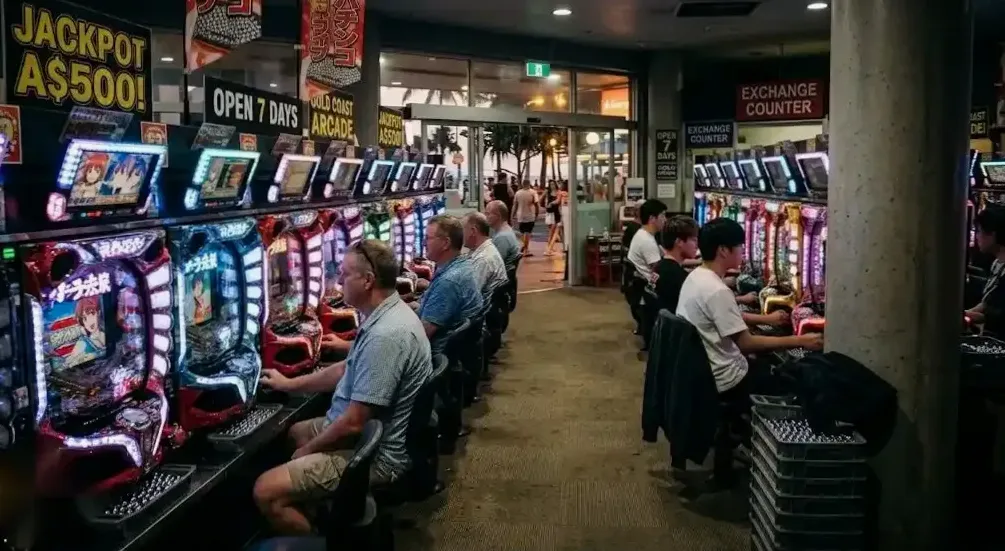
Walk past row twelve at the club and you can see the whole arc: a restored 1970s machine sitting next to a cabinet that released last year. The game underneath the chrome has barely changed. Everything around it has.
It started as a toy
Pachinko's ancestor is the Corinthian bagatelle board, a Western table game that reached Japan in the 1920s. Japanese toymakers shrank it to counter size and children played it in sweet shops for candy prizes. The name comes from pachin, the sound of the ball springing off the launcher, and the machine made that sound for decades before anyone played for money.
Postwar boom
The game exploded after the war. Nagoya opened the first commercial parlour in 1948, and within a decade pachinko was Japan's default evening out. The formula was already recognisable: steel balls, a nail field, a payout of prizes instead of cash. The prize workaround mattered. Japanese law prohibited cash gambling payouts, so parlours paid in goods that players sold at a discreet exchange window next door.
The machine learns to sing
Electrification in the 1970s added the centre features and animations that define modern machines. The 1990s brought licensed themes, video screens and the tulip pockets that turn a bonus into a cascade. By the 2000s pachinko was a trillion-yen industry, at one point reportedly generating more revenue than Japan's entire auto export business in some years.
How it reached Brisbane
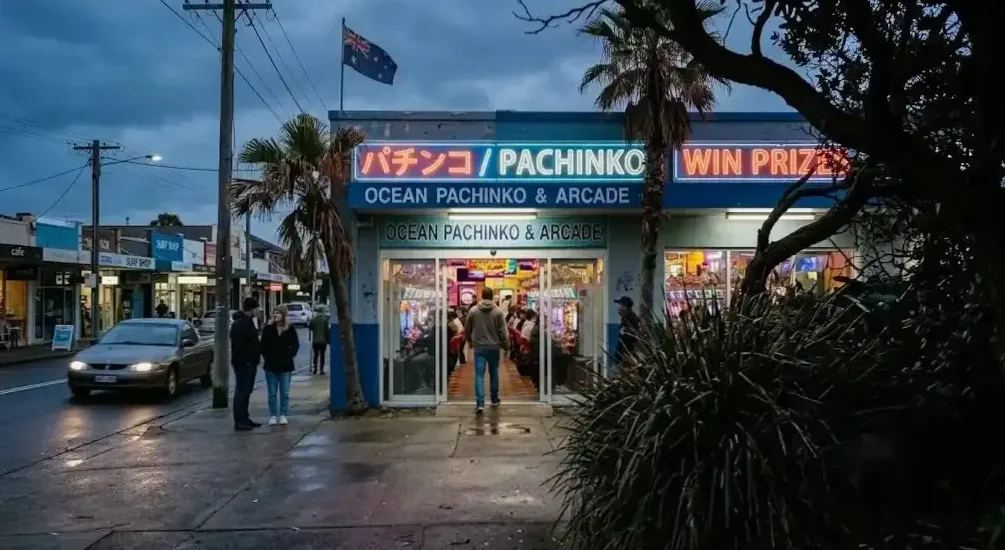
Pachinko barely travelled. Japanese parlours were culturally specific, language-locked and legally complicated to export. What changed it was tourism: Australians who played in Osaka and Tokyo came home wanting the experience without the flight. A handful of licensed venues in Sydney and Melbourne proved the market, and Pachinko Bounty opened in Brisbane in 2019 as Queensland's first dedicated club.
The Australian version
The local format keeps the machine play identical but simplifies redemption. Balls convert to bounty credit, credit converts to the prize wall, and the whole loop happens inside the club with no exchange window at all. It keeps the rhythm of a Japanese parlour while staying squarely inside Queensland licensing.
Why it keeps growing
The same reason it grew in 1950s Nagoya: it sits in the gap between skill and spectacle. The machines are loud and generous with their theatre, but the dial still rewards a steady hand. That combination, theatre anyone can enjoy and skill worth practising, has survived every entertainment trend for seventy years.
Key takeaways
- Pachinko began as a 1920s children's counter game in Japanese sweet shops.
- Nagoya's 1948 parlour started the commercial industry.
- Electrification and licensed themes built the modern machine.
- Pachinko Bounty opened in 2019 as Queensland's first dedicated club.
The machine changed completely three times. The game never changed once.
Asked about this topic
Quick answers related to this article. For the full club FAQ, head to our help centre.
Visit Help CentreYes. Our machines are genuine units sourced through licensed Japanese suppliers, refurbished and recalibrated for the floor.
Prize redemption is the traditional pachinko format and it keeps the club inside Australian amusement licensing. The bounty wall is the whole point.
Row twelve's vintage units run daily and can be reserved like any other machine. They play slower and are honestly harder than the modern cabinets.